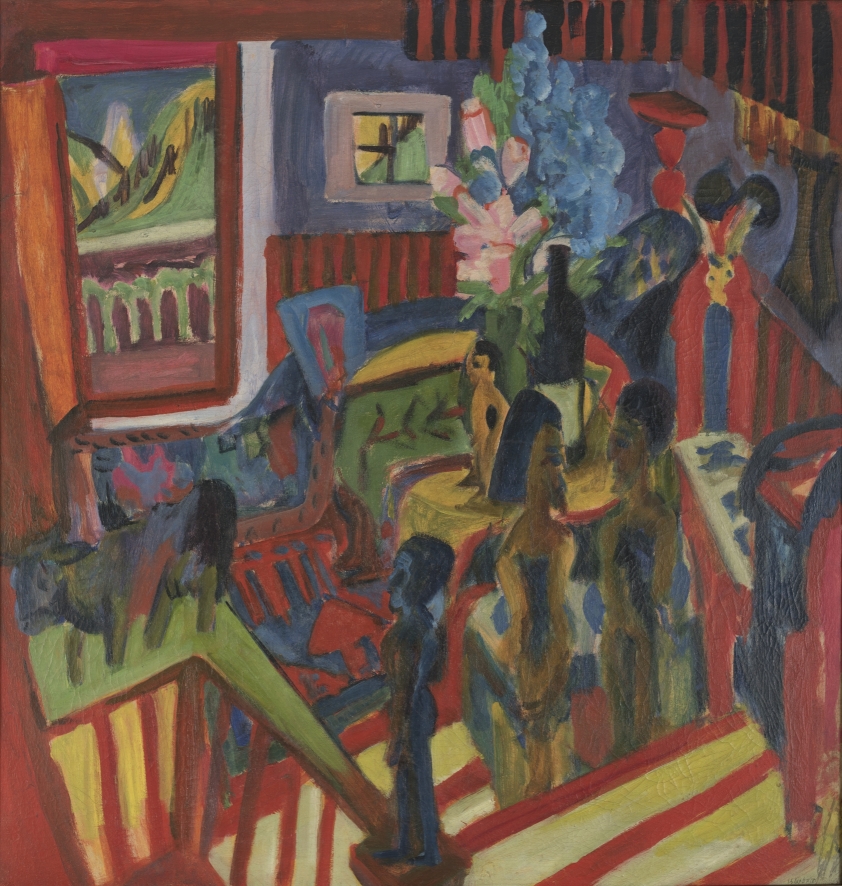
Studio Rooms. Modernity as a Contradiction. On Ernst Ludwig Kirchner’s «Atelierecke»
Several photographs provide insight into Ernst Ludwig Kirchner’s studios in Dresden and Berlin. The studios are furnished in great detail with wall-hangings, cloths, tablecloths, and wooden sculptures, the majority created by Kirchner himself. They can be seen in Kirchner’s Atelierecke (Corner of the Studio) in Davos. He made indiscriminate use of expression and form in designing his studio interior, combining Buddhist murals with the applied arts of Oceania and Africa. Kirchner acquired his knowledge from ethnological museum exhibits and racist “ethnological expositions” in which non-white people were presented to Western gawkers in a freak show-atmosphere.
We can conclude that Kirchner’s workshop insights were set in scene. The studios present the non-European art, which turned Kirchner’s eye to the ostensibly primitive and aboriginal for the first time, as the source of his artistic resistance to middle-class and technocratic society. In those artist’s rooms, traditional social norms were to be overturned and art and life were to merge and become the new epicenter of a transformation that would affect society at large. They herald a different future.
And yet Kirchner’s artworks reduced women and Black people to art objects. Aren’t the two life-size figures in Kirchner’s Atelierecke Milly/Milli and Sam, two Black artists that appear naked in a studio photograph from Dresden? Atelierecke turns them into the artist’s lifeless aesthetic inventory. Modernity, as seen in Kirchner’s works, is characterized by a contradiction. Despite its social utopia and the criticism of middle-class society, it repeats the colonial white viewpoint. In the end, the avant garde’s self-imposed criticism should have been directed at itself.
With that in mind, what can Kirchner’s Atelierecke tell us? Ask yourself how the studios of your thoughts and actions are furnished! What knowledge, fundamental beliefs, resentment, and prejudices do they contain? How can your critical attitude create a better future in your studios?